
How I Plan My Week Without Overplanning (And Why It Actually Works)

You don’t need a better planner.
You don’t need a color-coded, minute-by-minute schedule.
And you definitely don’t need to spend Sunday night trying to outthink the next five days of your life.
If weekly planning makes you feel resistant, boxed in, or already behind before the week even starts, I want to say this clearly:
That reaction is information — not failure.
Because overplanning doesn’t actually create clarity.
Most of the time, it just creates pressure.
After 30+ years of running businesses, managing teams, and helping service providers untangle their operations, I’ve learned this the hard way: when planning feels heavy, it’s usually because it’s asking you to ignore your real capacity.
So instead of giving you another “here’s my exact weekly schedule” breakdown, I want to walk you through how I actually plan my week — without overplanning — and why this approach works when so many others don’t.
When planning feels productive… but quietly creates resistance
Overplanning looks responsible.
It feels proactive.
It looks like you’re taking your business seriously.
It gives you that short-lived sense of control.
You sit down, list everything you could do, assign it neatly to days, and tell yourself, This is the week I stay on track.
Then Monday hits.
A client needs something unexpected.
Your energy isn’t what you thought it would be.
Life shows up, because it always does.
And suddenly that “perfect” plan feels impossible.
Here’s the part most people miss:
the resistance you feel isn’t laziness. It’s your nervous system responding to overload.
When a plan leaves no margin, your brain doesn’t experience it as support — it reads it as threat. And when that happens, execution doesn’t improve… avoidance does.
This is why overplanning quietly leads to procrastination, reshuffling tasks, and that constant feeling of being behind.
Busy isn’t the issue.
Overcommitted is.
And once you see that difference, everything changes.
Why planning harder isn’t the answer
When overplanning doesn’t work, the instinct is usually to fix it.
A different planner.
A more detailed system.
Stricter rules.
Tighter time blocks.
But the problem isn’t the tool.
It’s the assumption underneath it.
Most weekly plans are built around time, not capacity.
They assume:
your energy is consistent
tasks take as long as you think they will
nothing unexpected will happen
Bless.
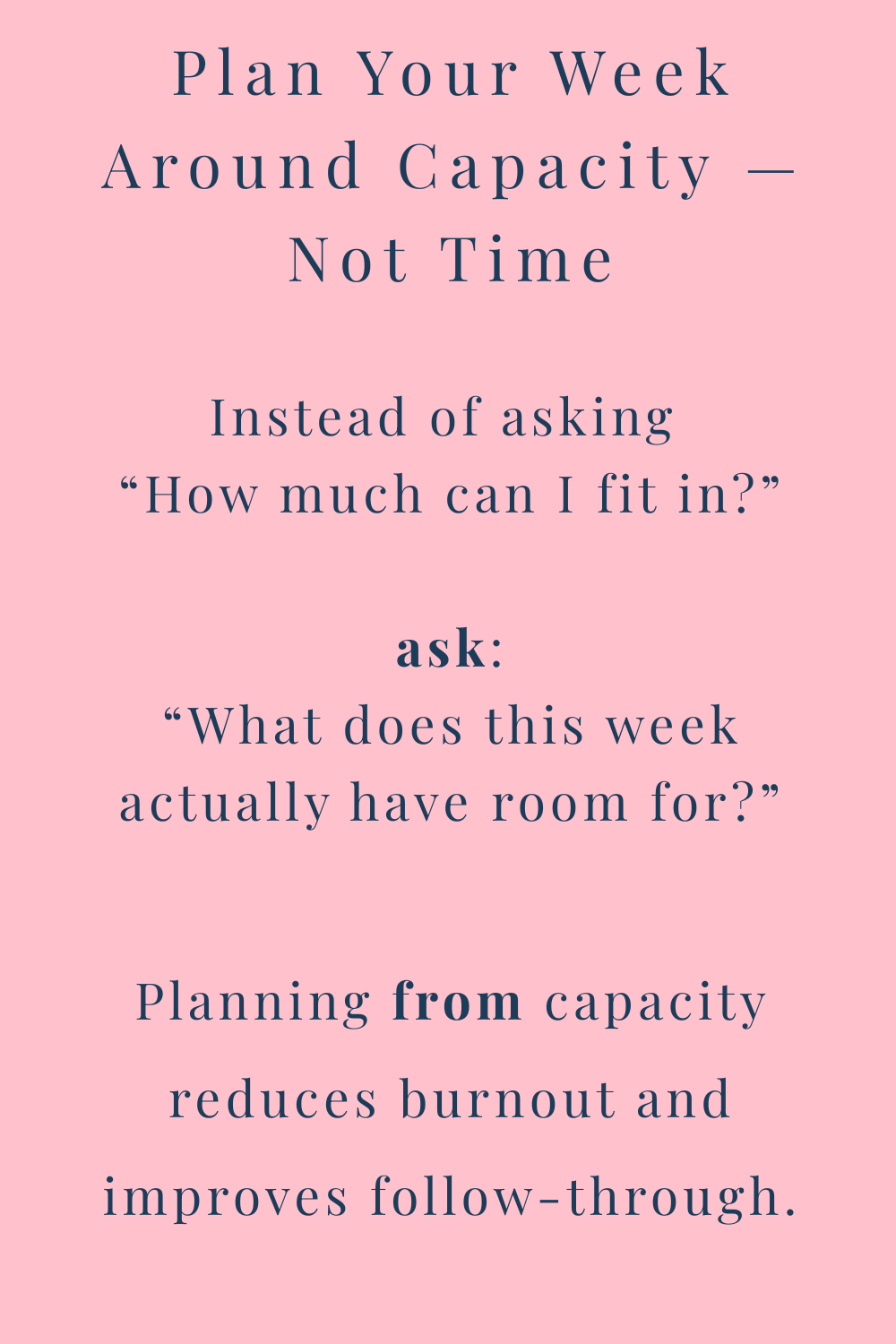
Time-based planning asks, How much can I fit into this week?
Capacity-based planning asks, What does this week actually have room for?
That question is where everything shifts.

Capacity-based planning: the burnout prevention nobody teaches
This is where my weekly planning changed completely.
I stopped asking how much I could do and started asking what this specific week could hold.
Capacity-based planning takes into account:
your energy
your focus
your current season
existing commitments (the real ones, not the ones you wish away)
Some weeks are heavy.
Some weeks need margin.
Some weeks are about maintenance, not momentum.
Ignoring that reality is how planning becomes an act of self-betrayal.
And listen — I say this as a lifelong doer. If it was on my calendar, it got done… even if that meant checking the last box at midnight. That badge of honor wears thin real quick.
Planning around capacity doesn’t lower your standards.
It stops you from planning for a fantasy version of yourself.
It also accounts for something we all underestimate: tasks that should take 10 minutes and somehow turn into two hours. When you plan with no buffer, those “quick things” quietly hijack your week.
Only when your plan matches how you actually operate does it start to feel realistic — and sustainable.
Where burnout actually comes from (and it’s not the work)
Here’s something that surprises a lot of people:
Burnout doesn’t usually come from the work itself.
It comes from the constant mental effort of figuring out what to do next.
When every day requires you to reassess, rearrange, and renegotiate your plan, your brain never gets to rest.
That’s where the real drain lives.
A client story I see all the time
I had a client come to me and say,
“I plan every week, but I still feel behind — and honestly, I’m starting to resent my business.”
On paper, her planning looked solid:
detailed task lists
color-coded days
clear intentions
But every single week was planned as if her energy never fluctuated.
Client calls stacked back-to-back.
Admin work squeezed into tiny gaps.
No margin for thinking, transitions, or life.
So instead of telling her to plan better, we asked one simple question:
What does this week actually have capacity for?
For the first time, she gave herself permission to plan less.
We trimmed the week down to what truly mattered.
Protected white space.
Stopped pretending every day needed to look the same.
The result wasn’t that she did more.
It was that she stopped feeling like she was constantly failing her own plan.
She said it best:
“Oh… I don’t hate planning. I hate planning weeks I can’t realistically live.”
And once the pressure lifted, her follow-through improved — without force.

Why fewer weekly decisions change everything
Here’s where it really clicked for her — and for me.
It wasn’t just how much she was planning that exhausted her.
It was the number of decisions she had to keep making during the week to compensate for a plan that didn’t match reality.
If your week requires you to decide what matters every single day, that’s exhausting.
Decision fatigue is real.
Without a clear anchor, every task becomes a debate:
Is this the best use of my time?
Should I be doing something else?
What if I’m missing something more important?
That internal noise is heavy.
So instead of planning everything, I reduce decisions.
At the start of the week, I decide:
what matters
what’s already accounted for
what is intentionally not happening
And then I stop renegotiating with myself.
Your to-do list shouldn’t be your business plan.
Your week should already know what it’s for.
The simple reset rhythm that protects future-you
Most people focus on starting the week strong.
Very few people end it intentionally.
That’s why Monday feels so hard.
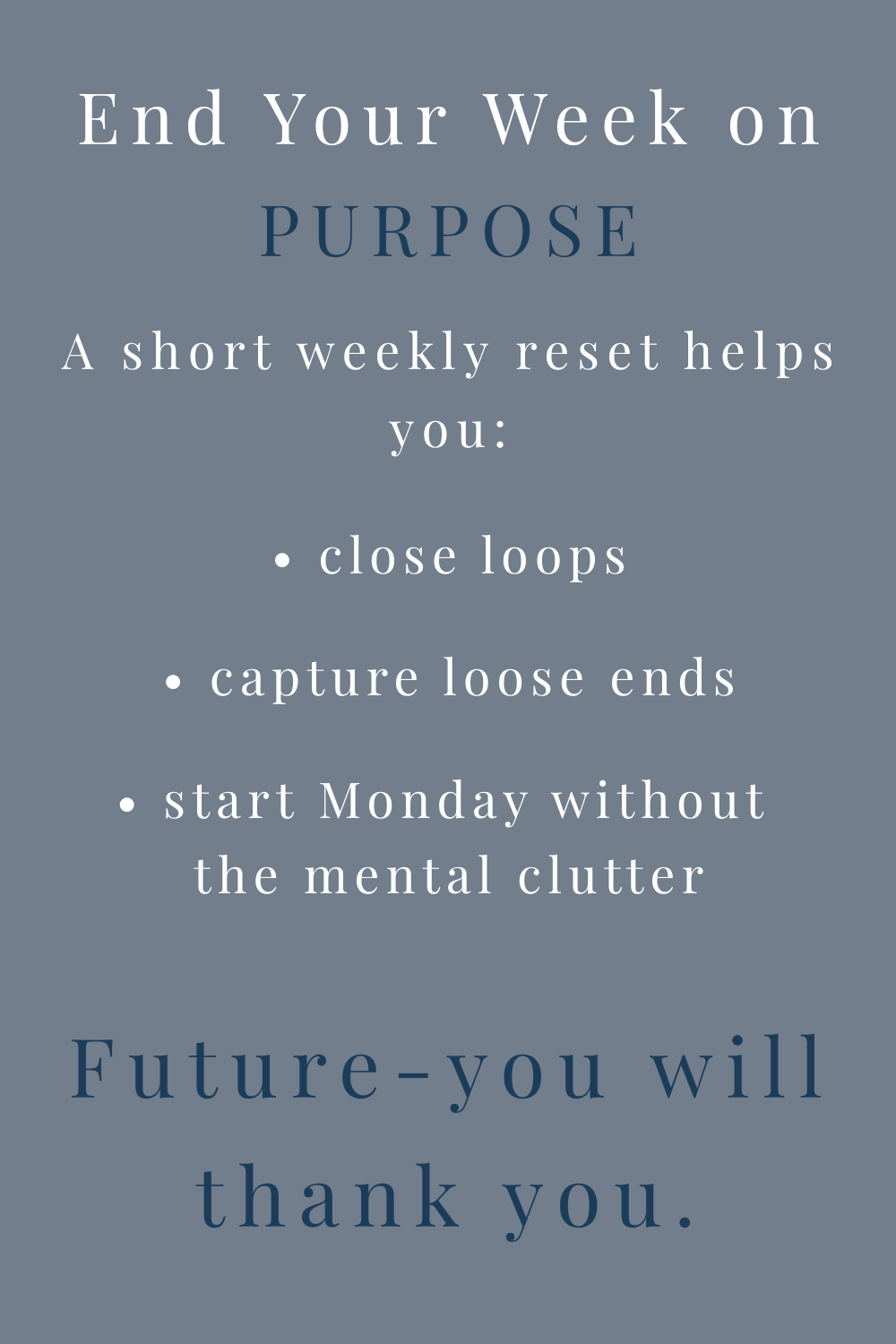
A reset rhythm is how you close the week without judgment:
noticing what moved
noticing what didn’t
capturing loose ends instead of carrying them in your head
This isn’t about perfection.
It’s about containment.
When you reset regularly, your business stops living in your brain — and future-you doesn’t have to clean up past-you’s mess.
Sticky notes aren’t a strategy.
But consistent reset rhythms absolutely are.
Why planning hasn’t worked yet
If planning has felt frustrating or discouraging, hear this:
You don’t hate planning.
You hate planning systems that don’t respect your capacity.
The goal isn’t control.
It’s leadership.
Leadership looks like creating just enough structure to support movement — without pressure.
Structure doesn’t box you in.
It sets you free.
Next Step?
This kind of weekly rhythm — capacity-based, flexible, repeatable — is something we intentionally build inside the Visionary to CEO program.
Not rigid schedules.
Not overengineered systems.
But weekly operations that actually support your life and your business.
If you’re ready to stop rebuilding your week from scratch every Monday, that’s where we slow this down and build it in a way that lasts.
Let’s anchor this
Overplanning creates resistance
Capacity-based planning protects your energy
Fewer decisions reduce mental load
Reset rhythms support future-you
Structure works best when it feels supportive, not suffocating
You don’t need another planner.
You need a weekly rhythm that works with you.
And you are absolutely capable of building that.
