
The 3 Foundational Systems Every Service Provider Needs Before Scaling
Let me start with a truth I’ve learned the hard way, both in my own business and after 30+ years in operations and business management:
Scaling without foundations is like building a wraparound porch on a house with no footing — it looks impressive, but collapses fast
Most of the women who come to me aren’t beginners.
They’re not Googling “how to start a business” at midnight.
They’re not wondering if their offer works.
They’re booked out or close to it.
Their calendar has real client work on it.
They’re good at what they do, and their clients tell them so.
They’ve got referrals rolling in.
They’ve got testimonials saved in a Google Doc somewhere.
They’ve proven more than once, that people will pay for their expertise.
And yet…
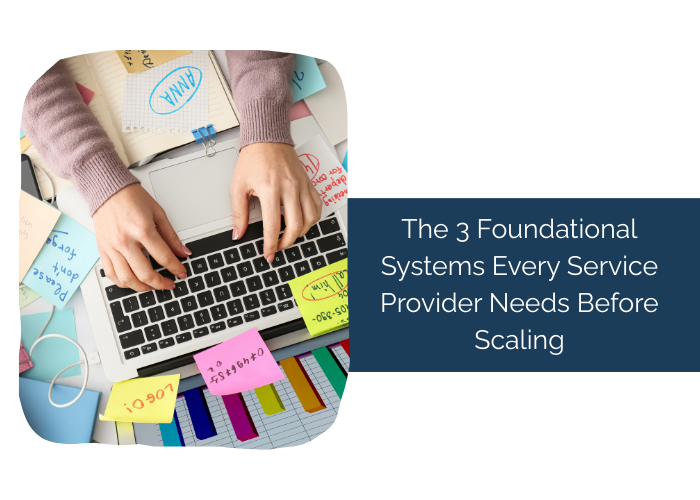
Behind the scenes, their business still feels like it’s being held together by sticky notes, memory, and that quiet promise they keep making themselves at 10:47 p.m.:
“I’ll fix this later, when things slow down.”
Client work gets done, beautifully, but everything else is duct-taped together.
Onboarding lives in someone’s inbox.
Processes live in their head.
Weekly planning happens on the fly, if it happens at all.
So every new client, even the exciting ones, adds just a little more weight.
Not because they can’t handle it.
But because nothing underneath the business was ever built to carry this level of success.
This is the stage where things get confusing.
From the outside, it looks like you’re doing great.
From the inside, it feels like you’re one missed email, one sick kid, or one surprise request away from everything wobbling.
And that disconnect messes with your head.
Because you start thinking:
“Why does this still feel so hard if I’m doing well?”
“Why am I exhausted when nothing is technically ‘wrong’?”
“Why does running my own business feel harder than running my clients’ businesses?”
That’s not imposter syndrome.
That’s not a mindset problem.
That’s what happens when growth outpaces structure.
You didn’t fail to plan.
You just haven’t been shown how to build the kind of backend that supports success after you’ve already proven yourself.
And honestly?
That’s a much better problem to have, once you know how to fix it.
Before you add more clients, more offers, or more visibility, you need a minimum viable backend — not a fancy one. Not a perfect one. Just a stable one.
There are three foundational systems every service provider needs before scaling. Miss even one, and growth starts pushing back instead of forward.
Let’s talk about them.
Why Scaling Without Foundations Always Backfires
Here’s what usually happens when foundations are missing:
You get more clients…
…but onboarding is inconsistent.
You raise your visibility…
…but delivery gets sloppy and exhausting.
You think about hiring help…
…but realize everything lives in your head, so delegation feels impossible.
So you do what most smart, capable women do, you work harder and hope things calm down eventually.
They don’t.
Because growth doesn’t create stability.
Stability creates capacity for growth.
That’s where these three systems come in. Lets look at....
System #1: Client Delivery (How Work Actually Moves)
If your business has a heartbeat, this is it.
Your client delivery system answers questions like:
What happens from the moment someone says “yes”?
How do you onboard them — every time?
Where does communication live?
How do projects move from start → to done without you mentally tracking everything?
When this system is missing, delivery becomes:
Over-customized
Over-communicated
Overwhelming
I once worked with a service provider who swore she didn’t need systems because “every client is different.”
Turns out, 80% of her delivery steps were identical, she was just reinventing them every single time.
Once we documented the flow (not a novel, just the steps), she shaved 6–8 hours a week off her workload without changing her offer at all.
Same clients.
Same quality.
Less chaos.
Let’s talk about System #2: Weekly Operations (This is the How You Run the Business)
This is the system most people skip and the one that quietly drains the most energy.
Your weekly ops system is how your business runs behind the scenes:
How you plan your week
How you review what’s done
How you track what matters (without spreadsheets everywhere)
How you reset when life happens
Without this system, every Monday feels like starting from scratch.
You’re reacting instead of leading.
And decision fatigue becomes your full-time job.
With it, you stop asking:
“What should I work on next?”
Because you already decided — before the week started.
This system doesn’t need to be fancy. It just needs to exist. which leads up to
System #3: Visibility (How People Consistently Find You )
Here’s the one that surprises people.
Visibility is a foundational system, not an add-on.
Not because you need to be everywhere. you don't.
But because relying on referrals alone is fragile.
Your visibility system answers:
Where do people consistently encounter your work?
How do they learn what you do without you explaining it 47 times?
What keeps working even when you’re busy delivering for clients?
When this system is missing, growth becomes feast-or-famine.
When it’s present, momentum compounds quietly in the background.
This doesn’t mean daily posting or chasing trends.
It means repeatable, relationship-driven visibility that fits your capacity.
(And yes, this is where community and collaboration matter more than algorithms.)
Lets look at What Happens When One System Is Missing (aka: why things feel harder than it should)
Here’s the pattern I see over and over and it’s usually not loud at first.
It starts as little “quirks” you brush off because you’re capable and you can muscle through.
Until you can’t.
Because when one of these systems is missing, the other two start compensating… and that’s when things get heavy. (And expensive. And mildly rage-inducing.)
When there’s no Client Delivery System → the burnout + scope creep begin to show up
This is the one that sneaks up on high performers, because you can deliver. You’re good. You care. And your clients love you.
But without a delivery system, your business runs on:
memory
“I’ll just do it real quick”
and a whole lot of invisible effort
Here’s what it looks like in real life:
1) Every client feels like a custom build.
Even if you offer the same service, you’re still reinventing the wheel:
different onboarding emails
different file setups
different communication threads
different project steps
2) Scope creep isn’t a client problem — it’s a structure problem.
When the process isn’t clear, everything becomes negotiable:
“Can we just add one more thing?”
“Can you hop on a quick call?”
“I thought this included XYZ…”
And because you’re kind (and tired), you say yes… then resent it later.
3) Your brain becomes the project manager.
You’re not just doing the work — you’re tracking the work, holding the timeline, remembering the next step, and anticipating what could go wrong.
That mental load is what causes burnout — not the work itself.
What this actually costs you:
Not just time, but energy. You end each day feeling like you ran a marathon… and somehow didn’t finish anything.
So you might be thinking-What kind of setup counts as “in place” — even if it’s not a polished system yet:
start with A basic client journey with 5–7 repeatable steps. A single onboarding checklist. and A clear “this is how we work” rhythm.
Not a corporate SOP novel. Just a known path.
Let’s look at what happens When there’s no Weekly Ops System → you get constant overwhelm + second-guessing
This is where you technically have a business… but operationally, you’re living in reaction mode.
And reaction mode is sneaky because it still looks productive. You’re moving. You’re doing. You’re checking things off.
But you’re not leading — you’re responding.
Here’s what that looks like:
1) Monday starts with panic instead of a plan.
You sit down, open your laptop, and immediately get hit with:
unanswered messages
scattered tasks
a calendar that doesn’t match reality
“Wait… what was I supposed to be doing this week?”
So you start triaging instead of executing.
2) Everything feels equally important.
When you don’t have a weekly rhythm, you don’t have a built-in decision filter.
So you make decisions in real time, all day long:
What should I do first?
What’s most urgent?
What can wait?
What am I forgetting?
That’s exhausting. And it’s why you feel “behind” even when you’re working constantly.
3) You lose momentum every time life happens.
A sick kiddo. A client emergency. A doctor appointment. A low-energy week.
Without a weekly ops system, there’s no reset button — so one off week turns into two, and then you’re rebuilding again.
What this costs you:
Decision fatigue + time leakage. It’s the “I worked all day but didn’t move anything forward” feeling.
What “present” looks like (not perfect):
A 30-minute weekly reset. Three weekly priorities. A simple check-in for money, client work, and visibility.
That’s it. That’s the whole magic.
When there’s no Visibility System → inconsistent income + panic marketing
This one is the quietest… until it becomes the loudest.
Because if visibility isn’t a system, it becomes a mood.
And a mood is not a marketing plan.
Here’s what it looks like:
1) Referrals carry you… until they don’t.
Referrals are amazing. I love them. Bless them.
But referrals are not predictable.
So you’ll have a season where clients are flowing and you think, “I’m good.”
Then you hit a slow month and suddenly you’re like:
“Do I need to post more?”
“Should I run a sale?”
“Maybe I should create a new offer?”
“Where is everybody?!”
That’s panic marketing. And it’s the fastest way to make marketing feel gross and draining.
2) Visibility becomes sporadic and stressful.
You post when you remember.
You email when you feel guilty.
You network when you’re desperate.
And because consistency isn’t there, results aren’t either — which makes you even less likely to stick with it.
3) You stay invisible to the people who would love to hire you.
This is the heartbreak of it. You’re great at what you do.
But if people aren’t consistently encountering your work, they can’t refer you, hire you, or remember you.
What this costs you:
Income swings + unnecessary stress. The kind where you start questioning your whole business even though nothing is actually wrong — you’re just under-marketing.
What “present” looks like (not perfect):
One visibility lane you can sustain:
a directory
a referral relationship strategy
a weekly email
a blog/podcast rhythm
a simple “where I show up” plan
Just one lane, done consistently.
You don’t need perfection — you need presence
Here’s the part I want you to really hear:
You don’t need all three systems to be polished.
You don’t need to have them automated.
You don’t need fancy tools.
You just need all three to exist.
Because when even one is missing, the business starts wobbling.
And you compensate with your energy, your time, and your sanity.
Think of it like a three-legged stool.
One leg missing doesn’t make you “almost stable.”
It puts you on the floor.
And if you’ve been crawling around trying to “push through” lately…
it’s probably not because you’re lazy or unmotivated.
It’s because one of your legs is missing.
A Quick Client Story (Because This Is Real Life)
One client came to me after a big growth spurt — more clients, higher revenue, zero breathing room.
She kept saying, “I should feel proud, but I just feel tired.”
We didn’t add new tools.
We didn’t overhaul her offers.
We didn’t touch her pricing.
We built:
a simple client delivery flow
a weekly operations rhythm
and a light visibility plan she could actually maintain
Within 90 days, her revenue stabilized, her weeks felt predictable again, and — her words —
“My business finally feels like it’s supporting me instead of chasing me.”
That’s what foundations do.
Permission to Start Small (You’re Not Late)
If you’re reading this thinking:
“I should already have this figured out…”
Let me stop you right there.
You’re not behind.
You’re right on time for the next layer.
Foundations aren’t built all at once.
They’re built intentionally — starting with what repeats.
One workflow.
One weekly rhythm.
One visibility lane.
That’s enough to change everything.
Next Steps?
If visibility feels like the weakest leg right now — especially relationship-driven, referral-friendly visibility — this is why I built the Strategic Collaboration Collective.
It’s not about louder marketing.
It’s about being in the right rooms, consistently, with people who already value collaboration over competition.
Growth doesn’t have to be loud to be powerful.
Sometimes it just needs the right structure underneath it.
And that, my friend, is how you scale without burning the whole thing down first.
