The Difference Between Being Busy and Being Structured

(And Why It Matters More Than You Think)
Let me say this gently… and then a little louder for the women in the back.
Busy does not mean productive.
I know. You’ve got a full calendar. Clients are happy. Your inbox stays loud. You’re crossing things off your list like a champ. And yet — somehow — you still feel behind, tired, and vaguely annoyed that your business needs so much of you to keep functioning.
That’s not a motivation issue.
That’s not a discipline issue.
That’s not a “you need to want it more” issue.
That’s the difference between being busy and being structured — and most women don’t realize they’re stuck on the wrong side of that line.
Let’s talk about why.
Before we go any further, we need to name something most women won’t admit out loud:
Busy feels good.
Not healthy-good. Not sustainable-good. But emotionally rewarding good.
Busy gives you instant validation. Proof you’re needed. Proof you’re valuable. Proof you’re doing it “right.”
When your calendar is full and your inbox is hopping, it’s easy to tell yourself, “See? I’m making progress.”
And for service-based business owners especially, busyness often becomes the receipt.
You don’t have a factory outputting widgets. Your work is relational. Mental. Invisible to everyone but you. So activity becomes the easiest way to measure worth.
Structure, on the other hand, doesn’t give you that same dopamine hit.
Structure is quiet. It works in the background. It doesn’t constantly ask for applause. And because of that, it can feel unfamiliar — even uncomfortable — at first.
That doesn’t mean busy is better.
It just means busy is louder.
And when you understand that, you stop judging yourself for being here — and start recognizing why it’s time for something different.
Why Busy Women Feel Accomplished… But Still Stuck
Busy feels good in the short term.
You answered emails. You handled client requests. You fixed the thing that broke. You reacted fast, showed up strong, and kept the wheels turning. That feels like progress.
But here’s what I’ve seen after 30+ years in operations and business management:
Busy women measure success by effort.
Structured women measure success by repeatability.
When your sense of accomplishment comes from how much you handled today, your business quietly trains you to stay in reaction mode. You become the solution to every problem. The memory bank. The reminder system. The glue.
And that’s why even successful, booked-out women say things like:
“I don’t know why this still feels so hard.”
“I should be further along by now.”
“If I just had more time…”
Busy creates motion.
Structure creates momentum.
And momentum doesn’t require you to hold everything together with sheer willpower.
Which brings us to the real problem.
This is the moment most women realize they’ve been measuring the wrong thing.
The Hidden Cost of Reaction-Mode Work
There’s another layer to this conversation that doesn’t get talked about nearly enough.
For a lot of women, the problem isn’t just reaction-mode work.
It’s identity.
When you’ve built a reputation as “the one who handles it,” being needed becomes part of how you see yourself. You’re the fixer. The responder. The dependable one. The person who can always jump in and make it work.
And here’s the uncomfortable truth:
If your business suddenly didn’t need you for everything… it can trigger a quiet panic.
If I’m not the one holding this together, where do I fit?
If I’m not busy, am I still valuable?
If I slow down, will everything fall apart?
Structure threatens that identity — not because it replaces you, but because it asks you to lead instead of rescue.
And leadership doesn’t require constant urgency.
This is why so many capable women resist structure without realizing it. Not because they don’t want ease — but because they’ve been rewarded for endurance.
Once you see this, you can start choosing structure without feeling like you’re losing yourself in the process.
Reaction mode is sneaky.
It doesn’t look like chaos. It looks like competence.
You’re responding. Solving. Adjusting. Fixing. Remembering. Repeating.
But every time your business depends on you to notice what needs to happen next, it adds weight you don’t see until you’re exhausted.
Here’s the cost most people don’t account for:
Decision fatigue from constantly choosing what to do next
Mental load from keeping recurring tasks in your head
Inconsistency because nothing happens the same way twice
Zero margin for rest, growth, or delegation
Reaction-mode work keeps you busy today but steals capacity from tomorrow.
And over time, that’s why businesses plateau — not because the owner isn’t capable, but because the business has no structure underneath the effort.
So let’s get really clear about the difference.
Busy vs. Structured (Side-by-Side)
Here’s what this actually looks like in real life:
Busy looks like:
Starting the week by rewriting your to-do list
Answering the same client questions over and over
Feeling productive but never caught up
Handling everything “as it comes”
Needing to be involved in every step
Structured looks like:
Knowing what happens every week without rethinking it
Client delivery that runs the same way every time
Clear priorities instead of endless tasks
Built-in systems that prompt action
Work continuing even when you step back
If you want to really feel the difference, look at it through these three layers:
1. Time
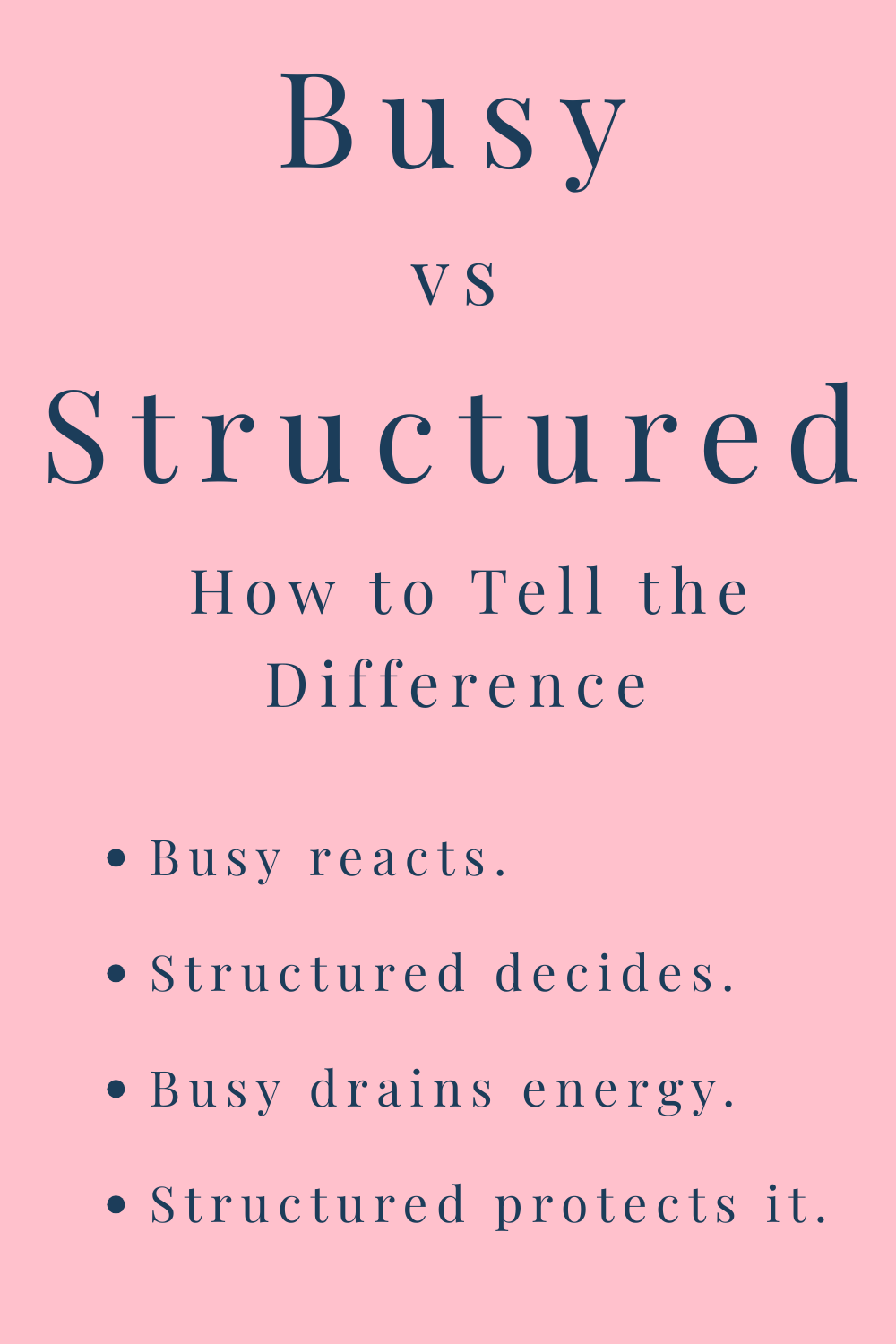
Busy fills the calendar.
Structure designs the week.
Busy reacts to what shows up. Structure decides ahead of time what belongs where — and what doesn’t.
2. Energy
Busy drains decision-making first.
Structure protects it.
When everything requires a choice, your brain is exhausted before noon. Structure removes hundreds of micro-decisions you don’t need to make anymore.
3. Growth
Busy caps capacity.
Structure creates leverage.
Busy asks, “How much more can I handle?”
Structure asks, “What can run without me?”
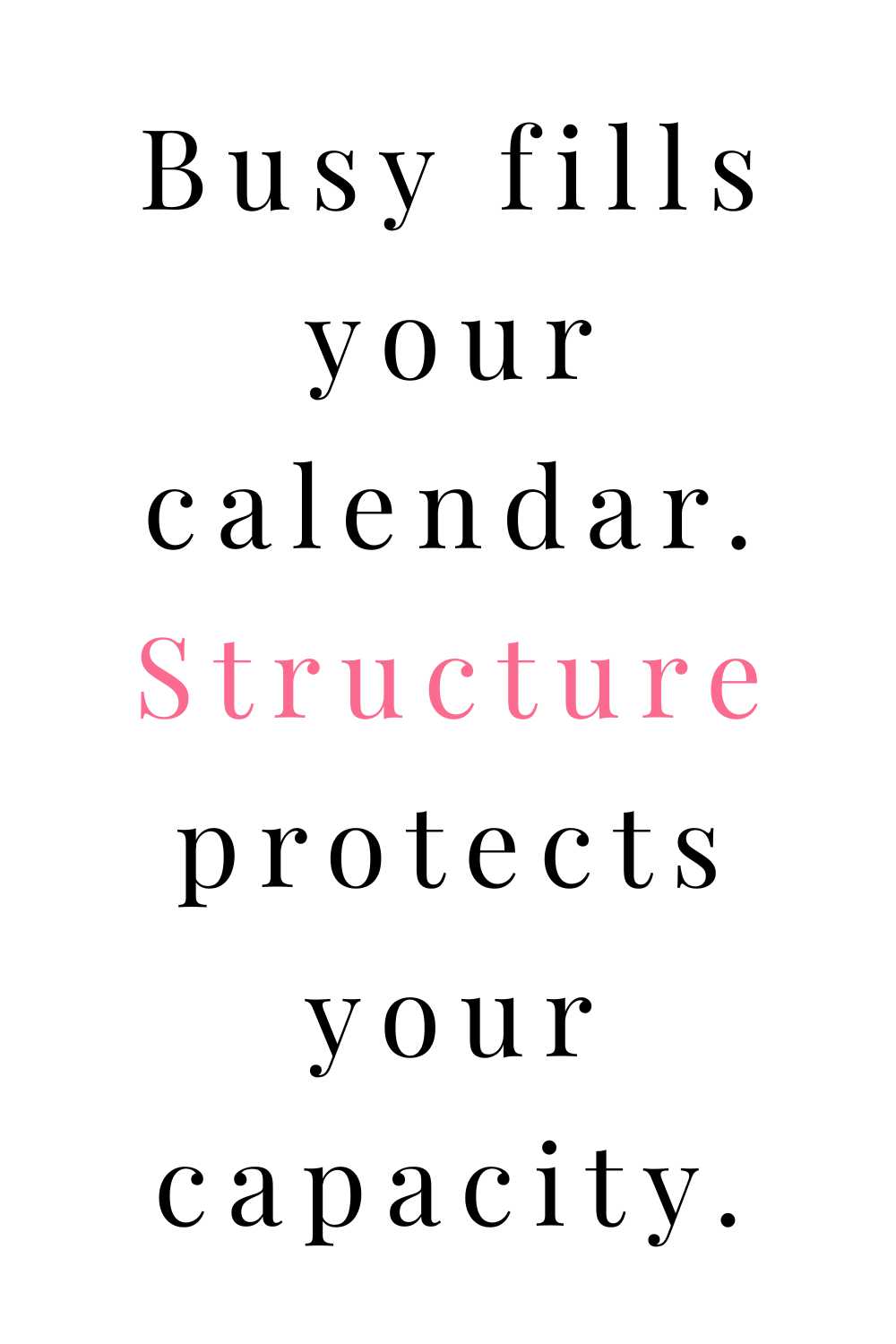
Busy fills your calendar.
Structure protects your capacity.
Busy depends on you.
Structure supports you.
And this is where a lot of women resist — because they’ve been taught that structure will box them in, slow them down, or make their business feel rigid.
That’s not how real structure works.
What Structure Gives You That Hustle Never Will
Before your brain jumps to conclusions, let me be very clear about something.
Structure is not:
Turning your business into a corporate machine
Over-automating everything until it feels cold
Color-coding your life within an inch of its sanity
Losing flexibility or creativity
That’s not structure. That’s overcomplication dressed up as productivity.
Real structure is supportive.
It’s a few clear workflows. Predictable rhythms. Decisions you don’t have to remake every week. Guardrails that hold things steady so you don’t have to.
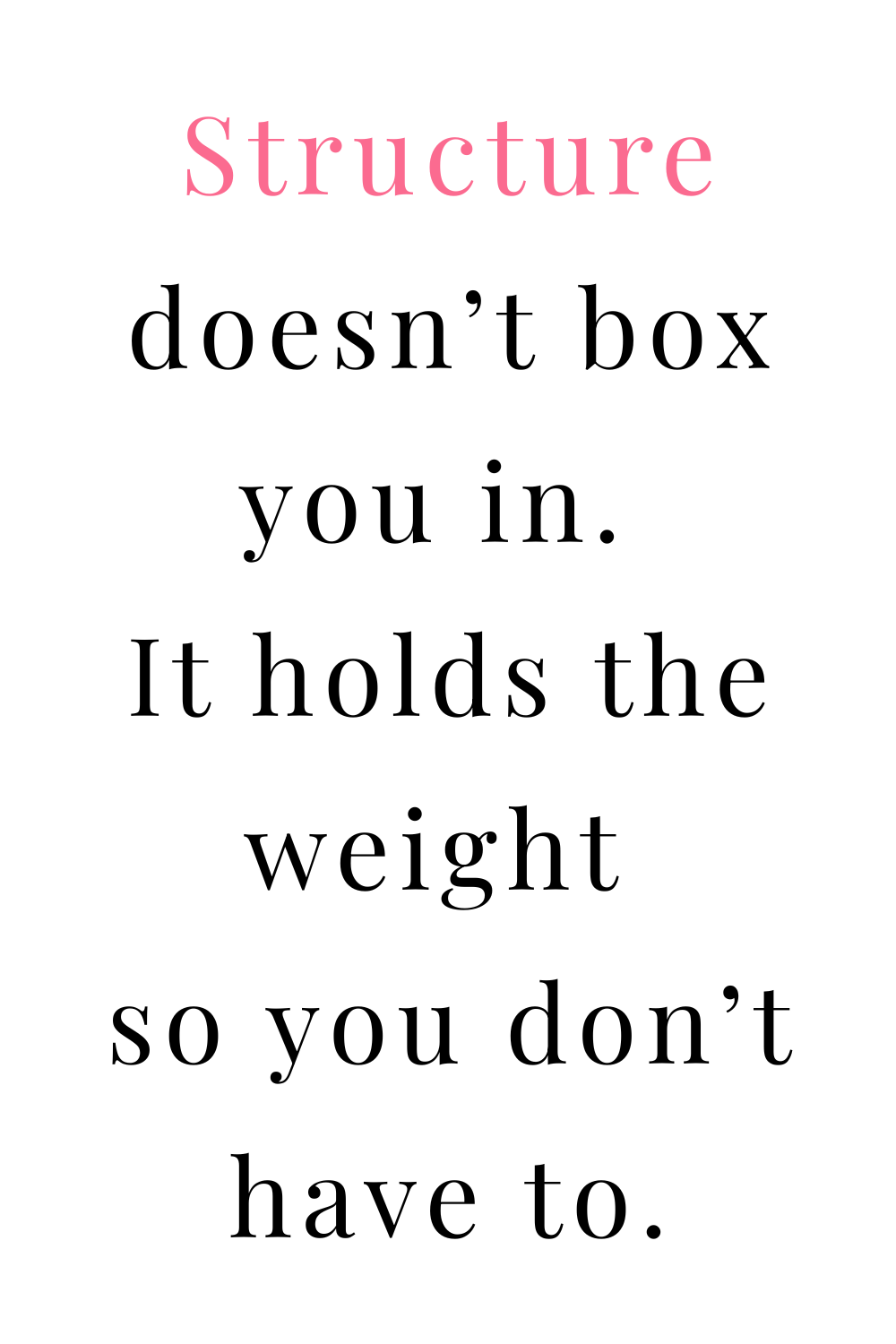
Structure doesn’t box you in.
It holds the weight so you don’t have to.
Hustle gives you output.
Structure gives you relief.
When structure is done right, it doesn’t add more to your plate — it removes the constant decision-making, remembering, and re-creating.
Structure gives you:
Fewer decisions because the path is already defined
More confidence because you know what’s working
Easier delegation because tasks live outside your head
Time back — not someday, but now
Space to actually lead instead of just respond
And the biggest one?
Structure lets your business stop living inside you.
You don’t lose flexibility.
You gain stability.
Which brings me to one of my favorite client shifts.
I see this pattern constantly — and it usually shows up in small, sneaky ways.
One client kept “just checking Slack” all day because she didn’t have a defined communication rhythm. Once we set clear check-in points, Slack stopped running her nervous system.
Another was manually onboarding every client from scratch — same emails, same steps, different Google Docs every time. We turned it into one simple repeatable flow and instantly removed hours of mental load.
And then there’s the classic one: the woman convinced she needs a new tool… when what she really needs is a checklist she can trust.
None of these women needed to work harder.
They needed fewer things living inside their heads.
Client Example: Same Workload, Fewer Hours
I worked with a client who was convinced she needed to work more efficiently.
She didn’t.
She had the same workload before and after we worked together. Same clients. Same offers. Same level of service.
What changed was this:
We identified what repeated every single week — onboarding steps, client communication, admin tasks, delivery rhythms — and gave those things a home outside her brain.
Within a few weeks:
She stopped working late “just to catch up”
Her week stopped feeling unpredictable
She cut her working hours by nearly a full day
Nothing magical happened.
We didn’t add tools.
We didn’t overhaul her business.
We didn’t chase productivity hacks.
We added structure.
And suddenly, her business started supporting her instead of leaning on her.
That’s the quiet power most people miss.

This is the shift most people don’t see until someone names it.
Reflection Prompt: “What Repeats Every Week?”
If you do nothing else after reading this, do this one thing:
Ask yourself:
What repeats every week in my business — even when I pretend it doesn’t?
Look for:
Tasks you rewrite over and over
Questions you answer on autopilot
Steps you mentally track instead of documenting
Work you touch every week without a system
Those repeating pieces are where structure will give you the fastest relief.
You don’t need to organize everything.
You just need to stop rebuilding the same things again and again.
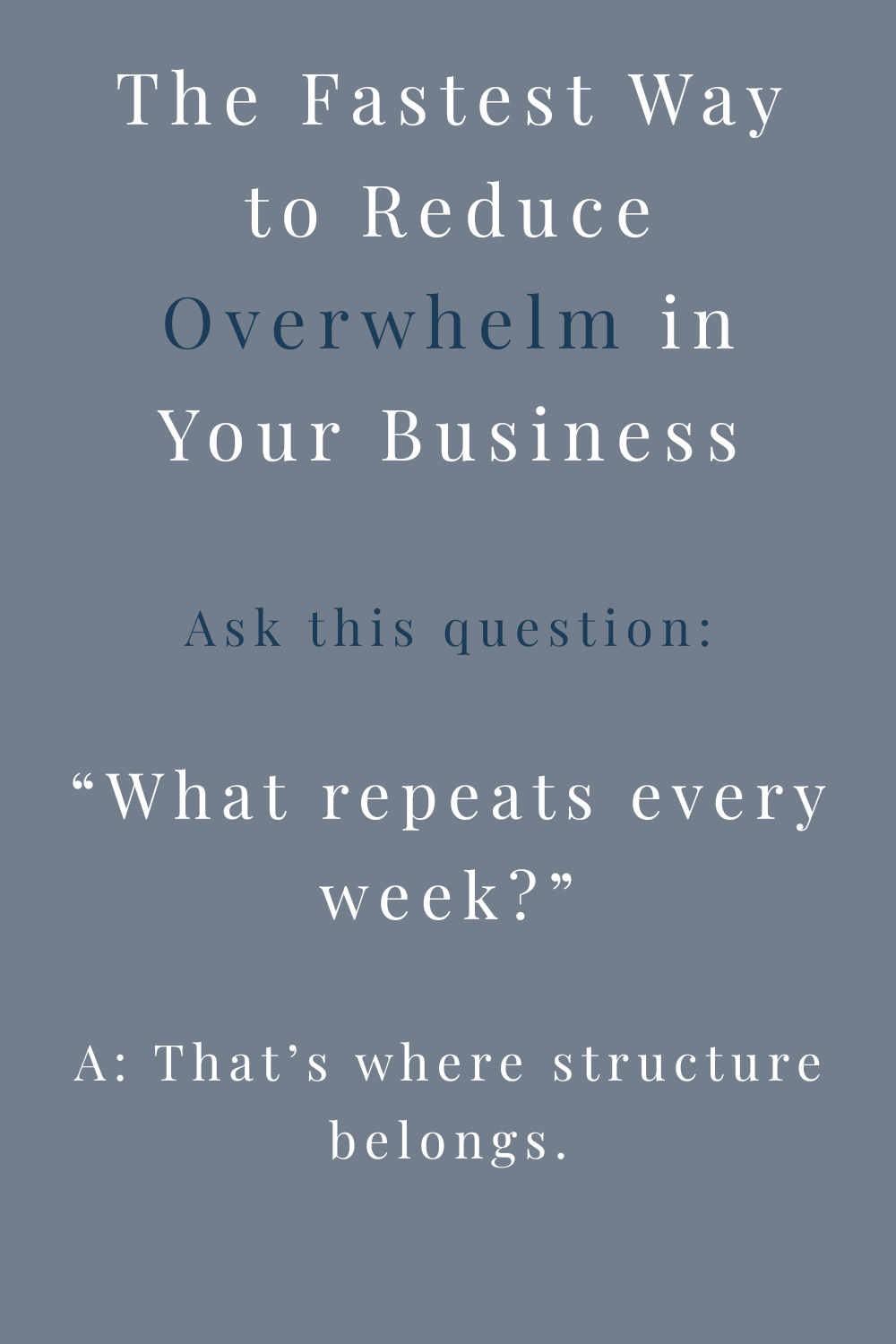
If you want to spot where structure will help you fastest, don’t start by fixing everything.
Start by noticing patterns.
Ask yourself:
What do I redo every single week?
What do I answer or explain over and over?
What quietly breaks or stalls when I don’t show up?
Those aren’t flaws in your work ethic.
They’re signals.
Anything that repeats is asking for structure. And when you start there, relief comes faster than you expect.
Next Steps You Ask?
If this post made you feel seen — not called out — you’re exactly who I built the Visionary Prep Pass for.
It’s not a course.
It’s not a commitment.
It’s a simple starting point to help you:
Get what’s in your head onto paper
Identify what actually needs structure
Create clarity without overwhelm
Because busy isn’t the goal.
A business that runs with confidence, clarity, and breathing room is.
And that starts with structure — not more hustle.
You’re not behind.
You’re just ready for a better foundation.