
Why Your Business Feels Heavier Than It Should


(And How Structure Lightens the Load)
There’s a quiet kind of exhaustion that doesn’t get talked about enough in online business.
Not the dramatic, falling-apart kind.
Not the “everything is on fire” kind.
The kind where things are technically working, but you still feel weighed down in a way you can’t quite explain.
You’ve built something real. You’ve put in the time. You’ve learned the skills. And from the outside, it looks like momentum. But on the inside, your brain never really shuts off. There’s always something to remember, something to manage, something to mentally hold together.
And that’s the part that messes with you.
Because when things are going wrong, it makes sense to feel overwhelmed.
But when things are going right… and you’re still tired?
That’s when the self-doubt creeps in.
So let me start here, because this is usually where my clients finally exhale:
You’re doing well.
Clients are coming in.
Revenue isn’t the problem.
So why does your business still feel… heavy?

Not “I need a nap” heavy.
I mean bone-deep, brain-always-on, can’t-ever-fully-shut-it-off heavy.
If you’ve ever thought, “I should be past this by now,” let me say this plainly:
You’re not failing.
You’re carrying too much in your head.
And that kind of weight adds up fast.
And that’s what makes this kind of exhaustion so confusing.
Because when you’re busy and struggling, the answer feels obvious: slow down, take a break, catch your breath.
But when things are objectively going well, when clients are happy, work is steady, and nothing is technically “wrong”, rest doesn’t quite touch it.
You take a day off… and your body might pause, but your brain doesn’t.
You step away… and the mental tabs stay open.
That’s usually the moment my clients say something like, “I don’t get it. I should feel better than this.”
If that sounds familiar, it’s not because you’re ungrateful, undisciplined, or burned out beyond repair.
It’s because you’re carrying a kind of tired that sleep alone can’t fix.
The kind of tired that rest doesn’t fix
Here’s the sneaky thing about mental load:
It doesn’t look like hard work.
This isn’t the kind of tired that goes away with a long weekend or a good night’s sleep.
You can rest your body and still wake up feeling behind.
You can take a day off and feel guilty the entire time.
You can slow down and somehow feel more anxious instead of refreshed.
That’s because this tired isn’t coming from effort alone.
It’s coming from mental load.
When your business lives in your head, your brain never clocks out.

Even when you’re not actively working, part of you is:
Replaying conversations
Mentally tracking what needs to happen next
Holding unfinished loops open
Wondering if you forgot something important
Bracing for the next decision
It’s like leaving every browser tab open and wondering why your computer is running slow.
And here’s the sneaky part:
Because you can carry it, because you’ve been capable and resourceful and “figured it out” for so long, you don’t realize how much energy it’s costing you.
So instead of resting, your brain stays on standby.
Instead of relaxing, you’re subconsciously managing the business in the background.
This is why rest feels ineffective.
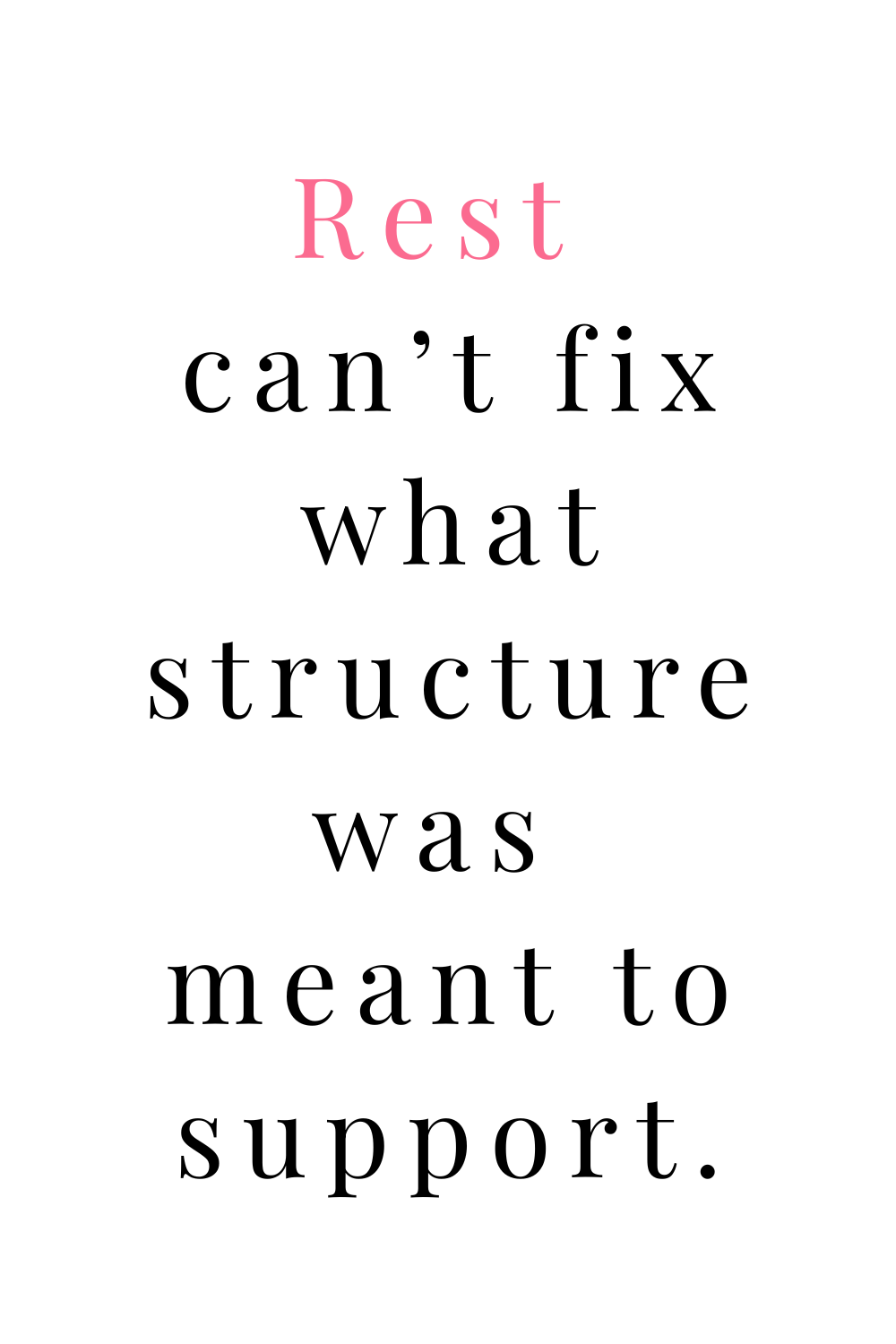
Not because you’re doing it wrong, but because rest can’t compensate for a system that only works when you are constantly thinking about it.
And this is usually the moment where high-capacity women start blaming themselves.
They think:
Maybe I need better time management
Maybe I just need to be more disciplined
Maybe I’m not cut out for this level of responsibility
But that’s not the truth.
The truth is, no amount of personal resilience can replace structural support.
Your brain wasn’t designed to be the CRM, the project manager, the reminder system, and the decision-maker all at once.
That’s not a motivation issue.
That’s not a mindset failure.
That’s not physical exhaustion.
That’s decision fatigue.
And no amount of motivation or discipline fixes that.
It’s a structure gap.
And once you see that, the tired finally starts to make sense.
Once you understand that this tired comes from mental load — not effort — something important clicks.
The exhaustion isn’t random.
It isn’t weakness.
And it isn’t a sign you’re doing too much wrong.
It’s a sign that too much is being held internally.
When every process, preference, deadline, and decision lives in your head, your business might look organized from the outside… but internally, it’s running on constant recall.
And that’s where the weight really starts to show up.
Because when your business lives in your head, it gets heavy fast.
Most service providers don’t realize this is happening because it doesn’t feel like chaos.
It feels like competence.
You know how things work.
You remember what each client needs.
You can jump in and make things happen quickly.
And for a while, that works.
But the cost shows up quietly.
Every time you start your day, your brain has to reconstruct the business:
What’s due?
Who needs what?
Where are things at?
What can’t be dropped today?
Nothing is technically wrong, it’s just all being rebuilt from memory, over and over again.
That’s exhausting.
When your business lives in your head, everything requires context switching. You’re constantly moving between client work, admin, planning, follow-up, and decision-making, without anything steady to land on.
So even small tasks feel heavier than they should.
Sending an email isn’t just sending an email, it’s remembering why, to whom, what comes next, and where it fits.
Starting a project isn’t just starting, it’s re-deciding how you do this this time.
And because you’re capable, you don’t stop to question it.
You just keep carrying it.
This is why your business can be profitable and still feel fragile.
Why growth feels exciting and overwhelming at the same time.
Why stepping away feels risky, even when nothing urgent is happening.
If everything runs through your head, then you are the bottleneck, not because you’re doing something wrong, but because there’s no external support holding the weight with you.
And here’s the part I want you to hear clearly:
This isn’t a personal flaw.
It’s not disorganization.
It’s not that you “should be better at this by now.”
It’s simply what happens when a business grows faster than its structure.
Your brain has been doing heroic work, but it was never meant to be the system.
And once that becomes true, the heaviness isn’t something you push through.
It’s something you build out of.
Once you see that the weight isn’t coming from laziness or lack of effort, the next question naturally becomes:
Okay… so what actually helps?
Not another planner.
Not a new tool.
Not “trying harder” to stay on top of things.
What lightens the load isn’t more doing, it’s support.
And that’s where structure comes in. Not the rigid, soul-sucking kind most of us picture, but the kind that quietly holds things steady so you don’t have to.
What real structure actually does (and what it doesn’t)
Let’s clear something up, because this is where a lot of folks get stuck.
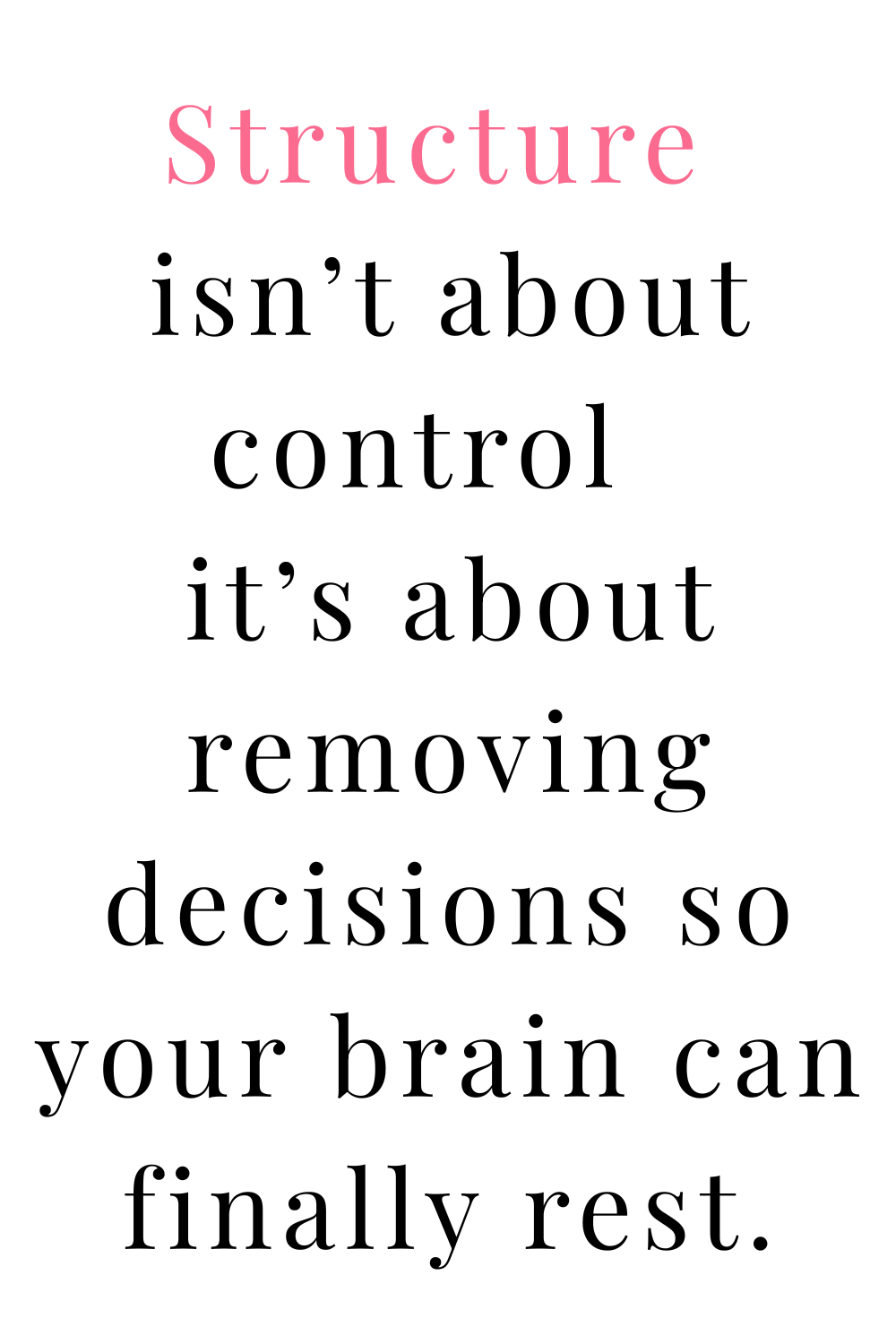
Real structure is not about control.
It’s not about squeezing yourself into someone else’s system or following a color-coded plan that looks good on Instagram and falls apart by Thursday.
And it’s definitely not about taking away your flexibility.
Real structure exists to reduce effort, not add to it.
Here’s what it doesn’t do:
It doesn’t limit your creativity
It doesn’t force you to work a certain way
It doesn’t require perfection or constant maintenance
If structure feels heavy, complicated, or suffocating, that’s not structure. That’s over-engineering.
What real structure does is far simpler and far more powerful.
It removes unnecessary decisions.
Instead of asking yourself:
“What should I work on first?”
“How do I start this?”
“What usually comes next?”
The answer already exists.
Structure is just a handful of pre-made paths for things you do repeatedly, client delivery, weekly planning, follow-up, admin, communication.
Nothing fancy. Nothing rigid.
Just enough clarity so your brain can stop holding the whole business together by sheer willpower.
And when that happens, something subtle but important shifts.
You don’t feel boxed in, you feel supported.
You don’t lose flexibility, you gain capacity.
You don’t become robotic, you finally have room to think again.
This is why structure doesn’t make your business feel smaller.
It makes it feel lighter.
Because the goal was never to control how you work.
The goal was to stop making everything a decision.
A quick client story (that might sound familiar)
I once worked with a client who was booked out and successful on paper, but exhausted all the time.
She kept saying, “I don’t even know why I’m so tired. I’m not doing anything crazy.”
When we looked closer, everything in her business was custom, manual, and mentally tracked. Same services. Same types of clients. But no consistent workflows.
We didn’t overhaul her business.
We didn’t add fancy tools.
We simply:
Mapped her client delivery once
Created a basic weekly flow
Got the recurring stuff out of her head and onto paper
Within a few weeks, she told me, “My weeks feel lighter. I’m not bracing myself every Monday anymore.”
Nothing changed externally.
Everything changed internally.
Once you understand what real structure actually does, there’s often a strong urge to jump straight into fixing everything.
To map workflows.
To clean up the backend.
To finally “get organized.”
But that’s not the most helpful first move.
Before anything changes, there’s a quieter and far more powerful step.
Because you don’t need to solve the whole thing today.
You just need to start noticing.
That’s where the real relief begins.
The gentle next step: notice where the weight really is
You don’t need a plan yet.
You don’t need a new system.
And you definitely don’t need to fix everything at once.
Right now, the most helpful thing you can do is simply pay attention.
Not to your to-do list, but to your energy.
Over the next few days, notice where your business feels heavy in a way that’s out of proportion to the task itself.
Where do you hesitate before starting?
Where do you feel that low-grade resistance, even when the work isn’t hard?
Where does your brain feel crowded or foggy instead of focused?
Those moments are clues.
Often, the weight shows up in places like:
Starting recurring tasks because there’s no clear starting point
Switching between roles and responsibilities all day
Remembering what’s been done versus what still needs attention
Holding client details in your head instead of having them clearly documented
Making the same small decisions over and over again
None of those are failures.
They’re signals.
They’re showing you exactly where your business is asking for structure, not more effort.
And here’s the important reframe:
You don’t need to eliminate the weight everywhere. You only need to identify one place where carrying it is no longer necessary.
Just one.
When you name it, you stop internalizing it.
When you see it clearly, it stops feeling so personal.
And when the weight has a name, it becomes something you can eventually design around.
This isn’t about fixing your business.
It’s about learning how to support yourself inside it.
Because clarity doesn’t come from doing more.
It comes from understanding where you’re doing too much in your head and giving yourself permission to let something else hold it instead.
Once you start noticing where the weight actually is, something shifts.
You realize you’re not overwhelmed everywhere.
You’re just carrying too much in a few key places.
And when that becomes clear, the question isn’t “What’s wrong with me?” anymore.
It becomes, “What would it look like to stop holding this alone?”
That’s where deeper support, the kind that creates lasting lightness instead of temporary relief, can make all the difference.
So if this post resonated, and you’re ready to keep peeling back the layers…
Want to go deeper?
This post pairs perfectly with Simple Systems for Service Providers Podcast Episode 13:
Why Your Business Feels Heavier Than It Should (And How Structure Lightens the Load)
🎧 You can listen to it here:
👉 Simple Systems for Service Providers – Episode 13
If you’re ready to start lightening the load without overhauling your entire business, grab our FREE Visionary Prep Pass – for getting what’s in your head out, organized and for reducing decision fatigue and finding your next right focus.
No pressure. No hustle. Just structure that actually supports you.
Because your business shouldn’t feel like it’s sitting on your chest.
And you don’t need to carry it all alone.
